The form
Cabaret and revue, explained
What the words cabaret and revue mean, where each form began in Paris and Berlin, and why a decades show in Prague is closer to a revue.
Reserve the cabaret ↗Two words, often mixed up
Cabaret and revue overlap, and many shows use both words. Cabaret, broadly, is theatrical entertainment of music, song, dance, recitation or drama, performed where the audience sits at tables, often eating or drinking, and usually introduced by a master of ceremonies. A revue is a multi-act show of music, dance and sketches with no overarching storyline, held together by a general theme. A decades show in Prague sits on the revue side of the line: numbers linked by a theme, with dinner tables in the room.
Where the word cabaret comes from
The word is old. It comes from Picard or Walloon words for a small room, and a written use appears in Tournai in 1275. In Middle Dutch it meant an inexpensive inn or restaurant. In Paris, cabarets existed by the late fifteenth century and differed from taverns because they served food as well as wine, on a tablecloth, charged by the plate. Writers such as Molière and Racine were known to meet in them. Entertainment came later.
Paris and the first modern cabaret
Le Chat Noir opened in Montmartre in 1881, founded by the impresario Rodolphe Salis, and is regarded as the first modern cabaret. Patrons sat at tables and drank while a variety show played on stage, and a master of ceremonies joked with well-known guests. Salis himself opened shows with monologues mocking the rich and the politicians of the day. Music halls followed in Paris from 1862, with more lavish costumes, singing and dancing, and competition from the cinema pushed them towards ever bigger spectacles in the twentieth century.
Berlin and Kabarett
German Kabarett began in 1901, when Ernst von Wolzogen opened the Überbrettl in Berlin; Munich's Elf Scharfrichter followed the same year. Censorship limited what performers could say until the end of the First World War. In the 1920s Kabarett flourished, known for political satire and gallows humour while keeping the intimate atmosphere of the French model. That satirical strand is the meaning German speakers still give the word, which is why some visitors expect sketches and jokes when they see cabaret on a poster.
The revue's golden years
The revue has roots in the popular entertainment of the 1800s, and it had its golden years between 1916 and 1932. The French word means review, as in a review of current events, and Florenz Ziegfeld popularised the French spelling from 1907. Revues were best known for visual spectacle, with solo performances alternating with dance ensembles, though they often satirised topical figures and fads as well. Composers and lyricists including Irving Berlin and George Gershwin wrote for them.
The Berlin cabaret most people picture
When visitors hear the word cabaret, many picture the Weimar Berlin of the musical Cabaret, Kander and Ebb's Broadway show, which is based on Christopher Isherwood's novel Goodbye to Berlin. That story is set in the years when German Kabarett was at its sharpest, before the Nazi party moved to repress it after 1933 and most German-speaking cabaret artists left for exile. It is a powerful image, but it describes one city at one moment. Revue shows for international audiences today draw far more on the spectacle of the music hall than on that smoky, political room.
What this means for your evening
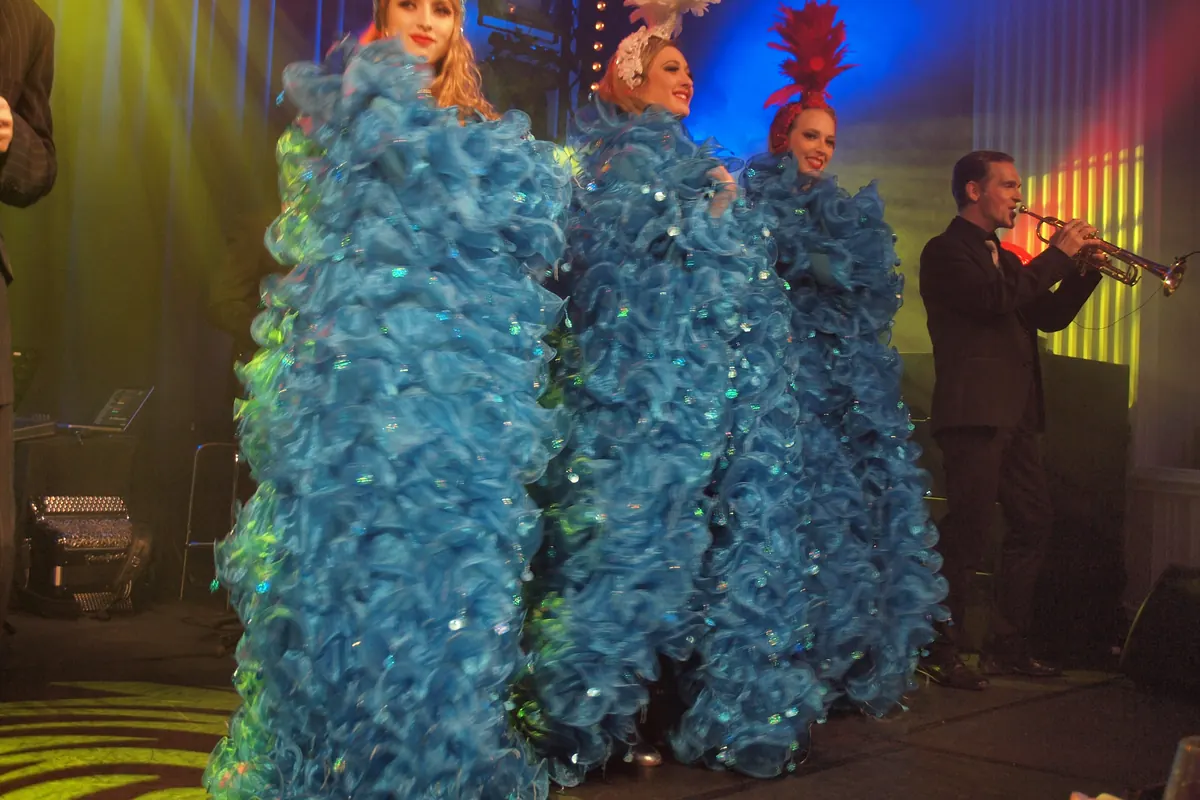
Knowing the difference sets expectations. A satirical cabaret depends on language and local politics; a revue depends on costume, music and movement, and travels across languages. The decades show in central Prague belongs to the second family, which is why international visitors can follow it without a word of Czech. The tables and the optional dinner borrow from the cabaret tradition, while the big ensemble numbers come from the revue. The guide to the show itself covers seats, dinner and timing.
Read next: Prague cabaret show: worth it?
Sources